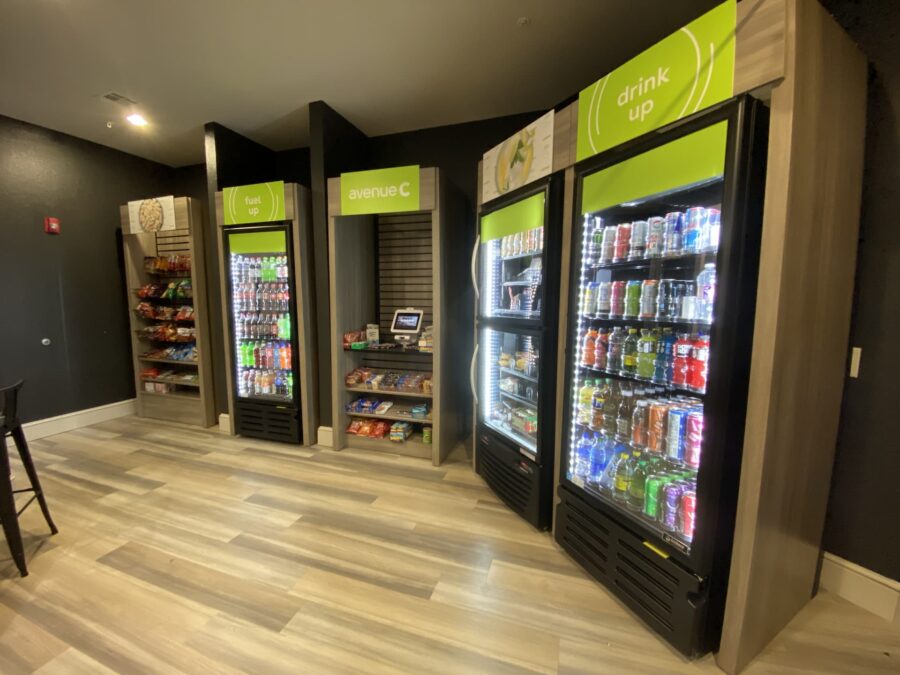
A micro market in your residence hall costs the property nothing. Chewings owns the equipment, holds the King County food permit, stocks it and services it. You provide lobby space and one 120V outlet. Students pay for what they take, and on qualifying sites we share a percentage of net revenue with the property.
Dining closes at nine. Studying does not.
Student demand is the inverse of a dining hall’s hours. The two windows that matter are 10pm to 2am during term, and the whole of finals week, and both are exactly when campus food service is shut.
What students do instead is leave the building. In the U District that means walking to the Ave at midnight. In Bothell, Lynnwood or Shoreline it usually means driving. Either way the property has handed a safety question and a satisfaction question to a student who just wanted something to eat.
We are based in Kenmore, which puts us a few minutes from the UW Bothell and Cascadia campuses and inside a short run of the U District, Shoreline and Lynnwood. Late restocks in student housing are a scheduling problem for an operator driving up from Kent. For us they are a normal Tuesday.
What students actually buy, by month
| Period | What moves |
|---|---|
| Move-in | Bottled water, cleaning wipes, toiletries, instant meals |
| Mid-term | Frozen meals, ramen, ice cream, snacks |
| Finals | Energy drinks, cold brew, anything at 1am |
| Winter | Hot-drink items, cold and flu remedies, tissues |
| Year-round | Painkillers, laundry pods, phone cables |
The catalogue runs past 3,000 items. Two categories matter more in student housing than anywhere else we operate: a real international range — Korean, Japanese, Chinese, Indian, Vietnamese, Indonesian and Mexican — which for a lot of students is the difference between a market they use and one they ignore, and household basics, because a residence hall is the only building type where people run out of laundry pods at midnight.
How it fits a residence hall
- Placement: the mail or package room, or the main lobby inside the card-access line. Keeping it behind access control means it serves residents and not the street.
- Footprint: four to six feet of wall, one standard outlet, no plumbing or build-out.
- Access for us: restock visits during business hours on a temporary or escorted card, the same as any campus vendor.
- Summer: we scale the product list down over the break and back up before move-in rather than leaving a full market to go out of date in an empty building.
Frequently asked questions
Do we need a permit for this?
A micro market in King County is a permitted food establishment and needs plan review from Public Health — Seattle & King County before it opens, under the Washington State Food Code, Chapter 246-215 WAC. Chewings is the permit holder. Housing staff apply for nothing and need no food worker cards.
Can students pay with a campus card?
The kiosk takes cards and mobile wallets. Campus meal-plan integration depends on the institution’s payment provider and is a separate conversation with your dining contract — worth raising early if it matters to you.
What about age-restricted products?
No alcohol and no nicotine or CBD products in student housing. Over-the-counter medicines follow the same rules as any retail shelf. Your housing office can veto categories outright.
Who approves what gets stocked?
Housing or dining services reviews the product list, and can change it each term. Allergen-aware, halal, kosher and vegetarian options are all sourceable — ask for them by name and they go on the list.
Does it compete with our dining contract?
It operates in the hours dining is closed, which is usually where the exclusivity language in a dining contract has room. Send us the relevant clause before the walkthrough and we will tell you straight whether it fits.
Book a walkthrough
We serve student housing across Seattle, Bothell, Kenmore, Lynnwood, Shoreline, Kirkland, Redmond, Bellevue and Everett from Kenmore. Book a free 30-minute walkthrough — best timed before move-in, when the product list can be built around your intake.

