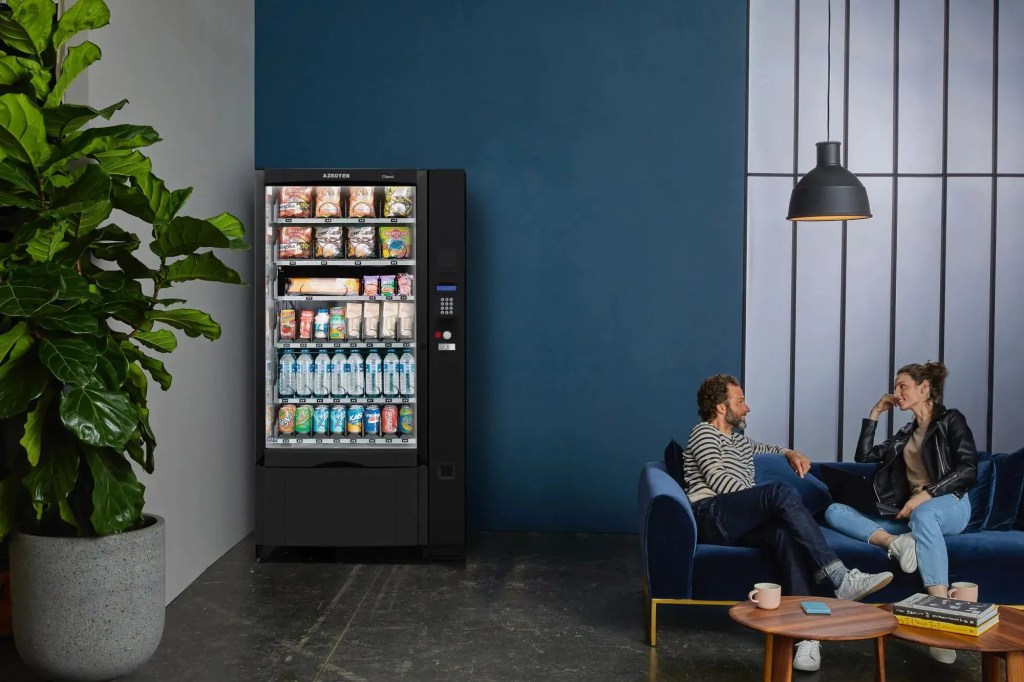
A lobby market costs the building nothing. Chewings owns the equipment, holds the King County food permit, stocks it and services it. The building provides four to six feet of wall and one 120V outlet. On qualifying sites we share a percentage of net revenue with ownership.
The multi-tenant problem this actually solves
In a single-tenant building, food is the tenant’s decision. In a multi-tenant building nobody owns the question, and that is why so many lobbies have nothing in them.
No individual tenant will fund a common-area amenity that mostly benefits the other floors. Ownership does not want a new operating expense on a building that is already competing on TI allowances. So the lobby stays empty, and everyone walks out for coffee.
A zero-cost market breaks that deadlock, because there is nothing to allocate. No tenant is billed, no opex line is created, and no committee has to agree on a split. It is the rare common-area improvement that does not require anyone to decide who pays.
Who uses a lobby market
More people than a breakroom market, and that is the point — a lobby serves everyone who enters the building, not one tenant’s staff.
- Tenants from floors with no kitchen — usually the smaller suites, who have the least ability to solve it themselves.
- Visitors and clients waiting on a meeting, which is when the lobby is doing its job as a first impression.
- Contractors, trades and delivery drivers in and out through the day — consistent, unglamorous volume.
- Security and building staff on shifts that start before and end after every café nearby.
Where it goes, and where it should not
| Placement | Works? |
|---|---|
| Alcove off the main lobby, in sight of the desk | Best |
| Elevator lobby on the parking level | Strong if most arrive by car |
| Beside a shared conference or amenity floor | Strong |
| Directly in the main sightline on entry | Usually rejected on design grounds |
| Street-facing and outside access control | Not advised |
The last row matters. A market inside the access-control line is used by the building. One that is effectively open to the street behaves like street retail, which is a different business with different losses. We will tell you if a placement falls on the wrong side of that line.
Fitting the design of the building
Lobbies are the one place where the objection is aesthetic before it is commercial, and it is a fair objection — a lit vending machine in a considered lobby looks wrong.
The cabinet-style coolers are built for this: finished exteriors in a range of materials rather than a backlit plastic front, and free design work to fit the market into the space you already have. If the building has a design standard, send it over before the walkthrough.
Frequently asked questions
Who signs — ownership or property management?
Whoever controls common-area use. It is a placement agreement for space, not a lease, so it usually sits well inside a property manager’s authority. Any revenue share is paid to whoever the agreement names.
Do we need a permit?
A micro market in King County is a permitted food establishment and needs plan review from Public Health — Seattle & King County before opening, under the Washington State Food Code, Chapter 246-215 WAC. Chewings holds it. The building applies for nothing.
What if a ground-floor tenant sells food?
Tell us before the walkthrough. Retail leases often carry exclusivity language on food and beverage, and we would rather find that in the lease than after install. Where there is a conflict we can usually narrow the product list, or the answer is no and we say so.
Does it need its own power circuit?
A standard 120V outlet is enough. No plumbing, no venting, no build-out, no permit on the building’s side.
What if it does not get used?
We remove it. There is no equipment to dispose of and nothing to buy out, because the building never owned it.
Book a walkthrough
We serve office and mixed-use lobbies across Seattle, Bellevue, Kirkland, Redmond, Bothell, Woodinville, Lynnwood, Shoreline, Renton, Issaquah and Everett from Kenmore. Book a free 30-minute walkthrough — bring your tenant roster and we will tell you whether the footfall supports it.

