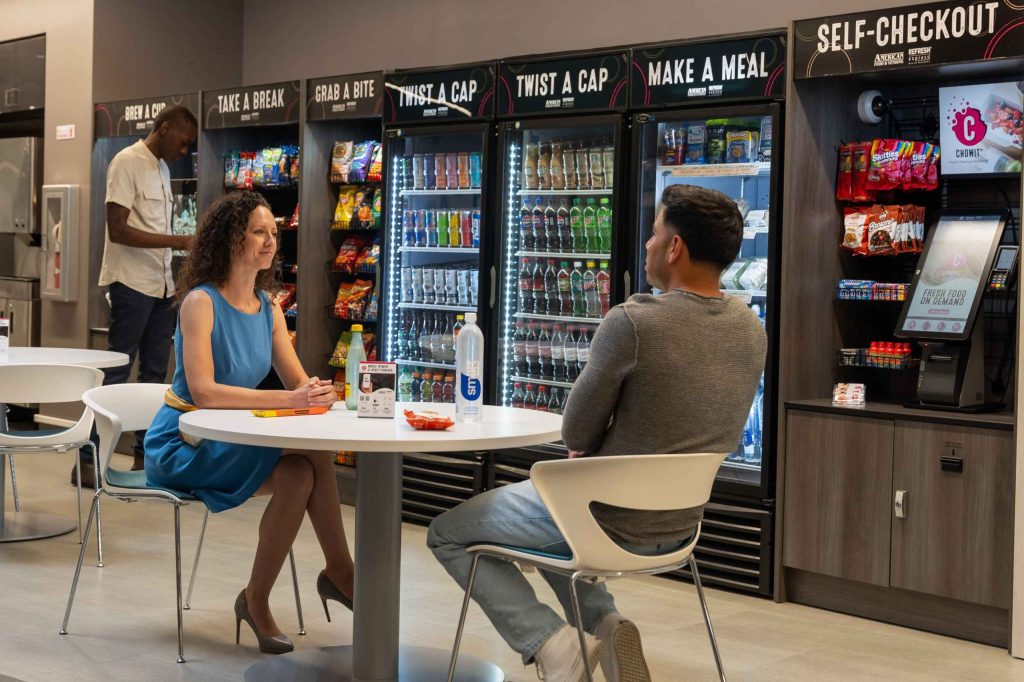
Breakroom services from Chewings cost the employer nothing. We own the cooler and shelving, hold the King County food permit, stock it and service it. You provide the wall space and one standard 120V outlet. Staff pay for what they take, at prices set against the corner store rather than against airport vending.
The problem is shift hours, not snacks
Most breakroom vending fails for a reason nobody writes on the machine: the people who need it most are working when everything else is shut.
Across the Kent Valley, Tukwila, Auburn and the industrial belt south of Seattle, second shift ends at 11pm and third shift runs straight through. A cafeteria that closes at 2pm serves one third of your staff. The nearest open shop is a drive, which turns a fifteen-minute break into a thirty-minute one — and on a line, that is the actual cost.
An unattended market runs all three shifts at the same cost. That is the whole argument. It is not a perk conversation, it is a coverage conversation.
Breakroom vending vs breakroom micro market
| Traditional vending | Micro market | |
|---|---|---|
| Product range | Packaged snacks and soda | Fresh meals, drinks, frozen, toiletries |
| Fresh food | No | Yes |
| Payment | Coin, bill, sometimes card | Card and mobile wallet |
| Sees the product first | Behind glass | Open shelf, pick it up |
| Health permit | Usually exempt | Permitted food establishment |
| Space needed | One machine footprint | 4–6 ft of wall |
| Cost to employer | $0 | $0 |
If your breakroom is small, or the site runs under about a shift’s worth of people at a time, a single smart cooler is usually the honest answer rather than a full open market. We will say so.
What gets stocked for shift work
Shift sites buy differently from offices. The pattern we see is real meals rather than snacks — frozen entrées, wraps, sandwiches — plus caffeine at the start of every shift, including the one that starts at 11pm, and over-the-counter painkillers, which move faster in industrial breakrooms than almost anywhere else.
The catalogue runs past 3,000 items and your team can request specific ones. We stock local brands — Ellenos yogurt, Molly Moon’s ice cream, Ladro coffee, Jones Soda, Marge granola — and a standing Korean, Japanese, Chinese, Indian, Mexican, Vietnamese and Indonesian range, which on a lot of Puget Sound production floors is the difference between a market people use and one they walk past.
Who is responsible for what
- Food safety and the permit — ours. A micro market in King County is a permitted food establishment under the Washington State Food Code, Chapter 246-215 WAC, and needs plan review before it opens. Chewings is the permit holder.
- Date rotation and temperature — ours. The coolers log temperature and flag faults on their own.
- Restocking — ours, on a schedule, plus extra visits when stock alerts fire.
- Product guidelines — yours if you want them. EHS or a wellness committee can rule out categories or require allergen labelling, and we source to it.
- Space, power and site access — yours.
Frequently asked questions
How does a micro market work?
Staff tap a card or phone at the kiosk, take what they want off the shelf or out of the cooler, and go. There is no attendant. Inventory reports back to us, so we know what to bring before you have to tell us.
Can we run it as a free or subsidised pantry instead?
Yes. Some employers cover part of the basket or open specific categories to staff at no charge and settle with us monthly. That is a different arrangement from the standard revenue-share model, so raise it at the walkthrough.
What about power outages?
The cooler alerts us on temperature and connectivity faults, and locks rather than opening up if it loses its connection. Product that goes out of temperature is discarded and replaced at our cost, not sold.
Does it work on a site with no cell signal?
It needs a data connection for payments. Most sites use the building’s wifi on a guest or device network. Warehouses with dead spots are worth flagging early, because placement may be decided by signal rather than by footfall.
How often do you visit?
Weekly for most sites, more often for high-volume ones. We schedule around shift changes rather than through them.
Great selection of products, super reliable, responsive, and always on top of everything. You can tell she really cares about providing great service and making sure everything is stocked, clean, and running smoothly.
Luke Z. · Google review
Book a walkthrough
We cover breakrooms across Seattle, Bellevue, Kirkland, Redmond, Bothell, Woodinville, Lynnwood, Shoreline, Renton, Issaquah, Everett and the Kent Valley from our base in Kenmore. Book a free 30-minute walkthrough — bring your shift pattern, it is the number that decides this.

