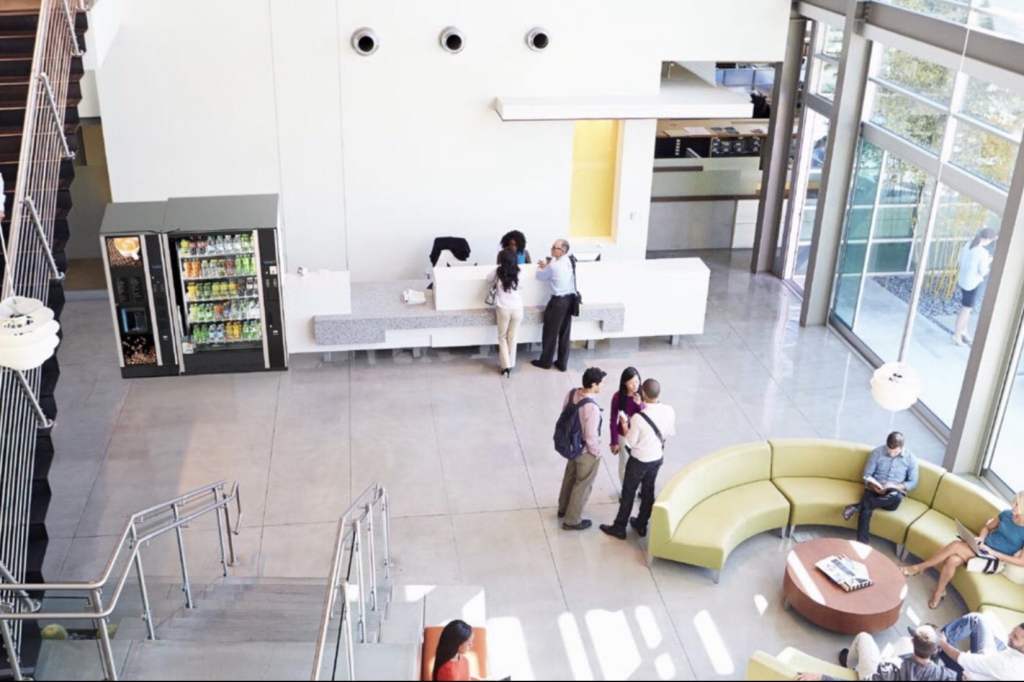
Yes, you can put a vending machine or micro market in an apartment complex, and it costs the property nothing. Chewings Amenities owns the equipment, holds the King County food permit, carries the liability insurance and restocks it. The building provides floor space and one standard 120V outlet. On sites that meet our foot-traffic minimum, we share a percentage of net revenue with the property.
Can I legally put a vending machine on my property?
This is the question property managers ask first, and the answer in King County is more specific than most people expect.
A micro market — open shelving plus a refrigerated case and a self-checkout kiosk — is a permitted food establishment. Public Health — Seattle & King County runs a dedicated Micro-Market (Unattended Retail) plan review, and the operation falls under the Washington State Food Code, Chapter 246-215 WAC. Plan review happens before the market opens, not after.
Chewings holds that permit and files that plan review. The property is not the permit holder, is not the person in charge, and does not need a food worker card. What the building signs is a placement agreement for the space.
What it costs the property
| Item | Who pays |
|---|---|
| Cooler, shelving and kiosk | Chewings |
| Installation | Chewings |
| Product and restocking | Chewings |
| King County food permit and plan review | Chewings |
| Liability insurance | Chewings |
| Security camera on the market | Chewings |
| Floor space and one 120V outlet | Property |
| Revenue share on qualifying sites | Paid to the property |
There is no capital outlay, no lease, and no minimum purchase. If it does not perform, we take it out.
Where it goes in the building
The best placement in an apartment complex is rarely the lobby. It is wherever residents already stop on the way in.
- The package room. Everyone visits it, most of them in the evening, and it is usually already access-controlled.
- Beside the fitness room. Catches people on the way out of a workout, when they are most likely to buy a drink.
- The mail alcove or elevator lobby on the garage level, for buildings where most residents arrive by car.
- The resident lounge, if it gets genuine daily use rather than being an events-only room.
Footprint is small — a four to six foot run against a wall. No plumbing, no venting, no build-out, no permit on the building’s side.
Why it matters more in Seattle than it used to
Two things changed. Buildings that leased on gyms and rooftop decks now compete against a dozen others with the same gyms and the same decks, so the amenity that gets mentioned on a tour has to be one the building next door does not have. And a lot of new supply on the Eastside and in Seattle’s denser neighbourhoods sits where the nearest late-night shop is a genuine drive rather than a walk.
A stocked market answers both: it is visible on a tour, and it is the thing a resident actually uses at 11pm when the alternative is getting back in the car.
What residents find in it
Over 3,000 items in the catalogue, and the property can request specific ones. Residential sites skew to the things people run out of: milk, eggs, bread, frozen meals, ice cream, painkillers, toothpaste, toilet paper.
We also stock local — Ellenos yogurt, Molly Moon’s ice cream, Ladro coffee, Jones Soda, Marge granola, Hot Cakes desserts — plus a standing Korean, Japanese, Chinese, Indian, Mexican, Vietnamese and Indonesian range. A national operator runs a national planogram. We buy in the same city your residents live in.
Frequently asked questions
What stops residents taking things without paying?
The cooler unlocks only after a valid card or wallet tap, and the market has a camera on it. In a residential building the stronger deterrent is that it is not anonymous — every transaction is tied to a payment method, and residents know it.
How many units does a building need?
Unit count matters less than where the market sits and how residents move through the building. A well-placed market in a mid-size complex outperforms a badly placed one in a large tower. We will tell you at the walkthrough if the traffic is not there.
Who handles it when something expires?
We do. Date rotation and food safety sit with the permit holder, which is us. Your on-site team is never responsible for stock.
Can we brand it as a building amenity?
Yes, and we prefer it. Seasonal promotions run under the property’s name — residents should see the value as coming from their building, not from a vendor.
What if we want it gone?
We remove it. There is no equipment for the property to dispose of and nothing to buy out, because the property never owned it.
We use Chewings Amenities at our apartment complex and absolutely love the service. Kylie is also such a pleasure to work with!
George, apartment complex · Google review
Book a walkthrough
We serve apartment complexes across Seattle, Bellevue, Kirkland, Redmond, Bothell, Woodinville, Lynnwood, Shoreline, Renton, Issaquah and Everett from Kenmore. Book a free 30-minute walkthrough and we will walk the building with you.

